AWS Cloud Data Pipeline
Designed an end-to-end serverless data pipeline using AWS to automate data ingestion, ETL, cataloging, and SQL-based analysis.
AWS · S3 · Lambda · Glue · Athena · ETL
Key Insights
- Serverless architecture reduced operational complexity while maintaining scalability across the analytics workflow.
- Converting raw CSV files to Parquet improved query performance and reduced storage and analytics costs.
- Event-driven automation using S3 triggers and Lambda eliminated manual pipeline execution and improved reliability.
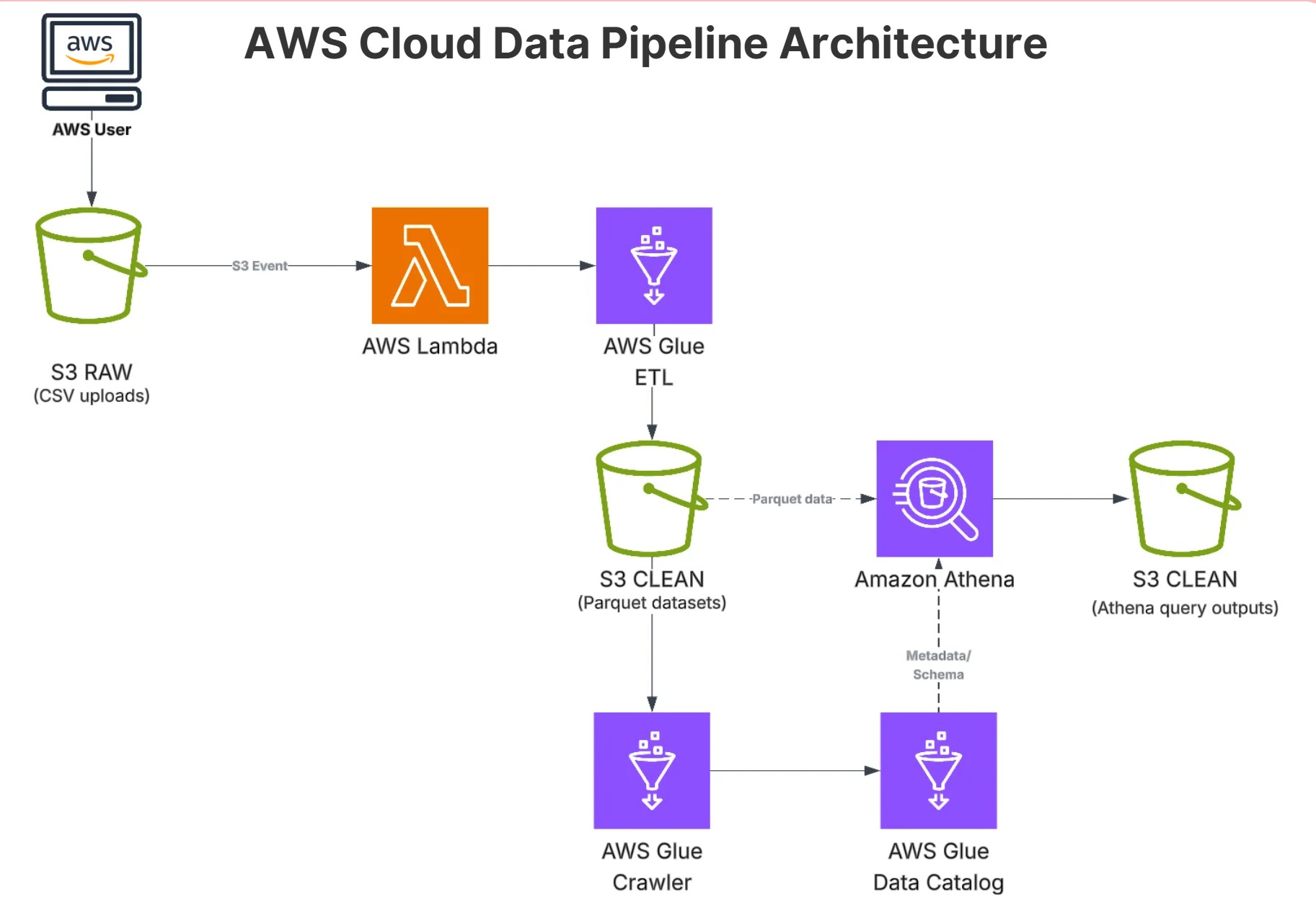
Project Overview
This project involved designing and deploying an end-to-end analytics pipeline using Amazon Web Services (AWS). The objective was to move beyond traditional data analysis workflows and implement a cloud-native architecture capable of automated ingestion, transformation, storage, cataloging, and SQL-based analytics.
Using AWS services including S3, Lambda, Glue, Athena, and the Glue Data Catalog, the team built a serverless workflow that automatically processes raw datasets, transforms them into optimized Parquet files, and makes them available for analysis through SQL queries.
The project emphasized architectural design, IAM-based security, cloud best practices, automation, and cost-efficient analytics using modern data engineering concepts.
What I Worked On
- Helped define the overall pipeline architecture and analytics workflow, evaluating AWS services and shaping the serverless design approach adopted by the team.
- Coordinated project planning and team collaboration in a Scrum-style workflow.
- Participated in designing the data lake structure using separate RAW and CLEAN zones within Amazon S3.
- Contributed to ETL workflow design using AWS Glue and Parquet-based optimization strategies.
- Configured and tested integrations across S3, Lambda, Glue, Athena, Crawlers, and the Glue Data Catalog.
- Evaluated architectural alternatives including Amazon RDS and EC2 before selecting a fully serverless solution.
- Presented the project objectives, architecture overview, and final conclusions during the team presentation.